
Why You Should Be Charging Licensing Fees for Publication Use of Your Images
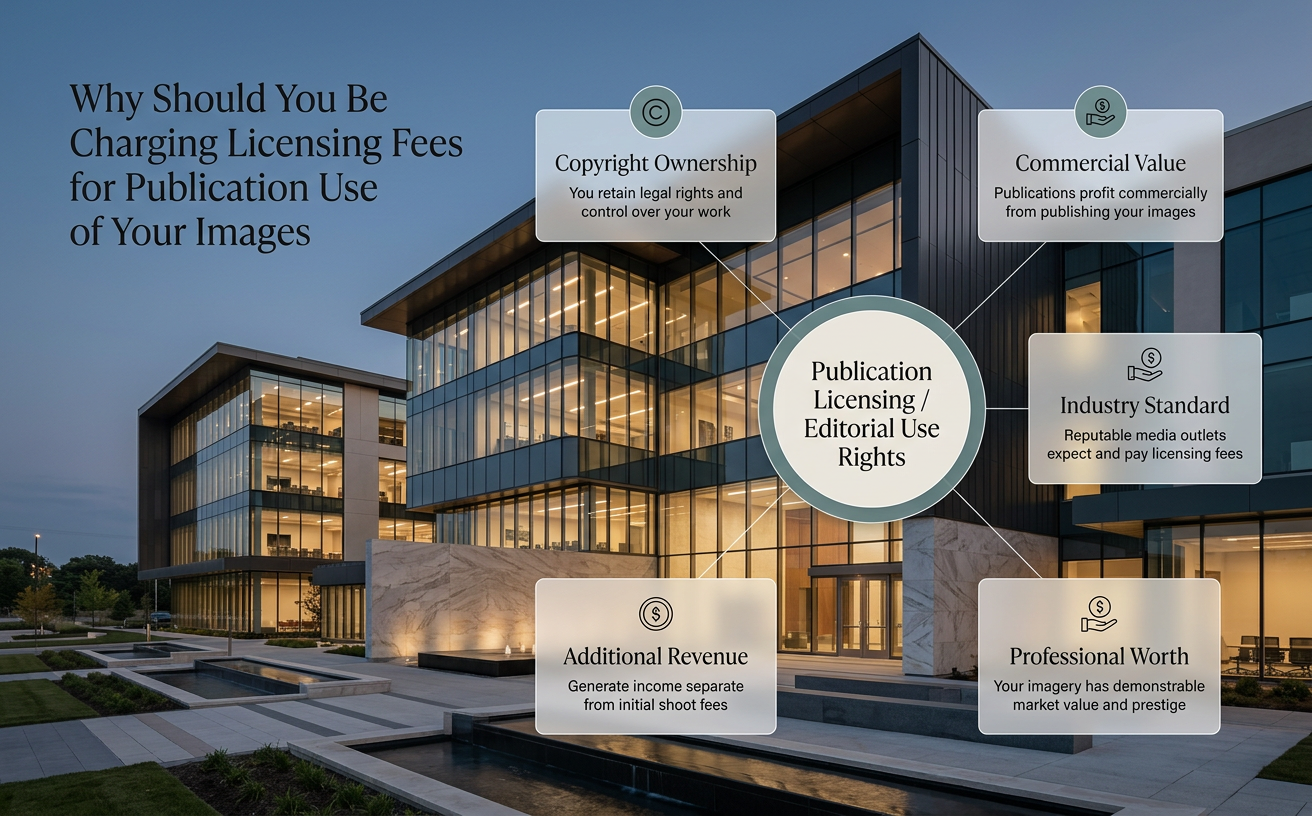
Why You Should Be Charging Licensing Fees for Publication Use of Your Images
As photographers, we put a huge amount of time, skill, and resources into creating images that help clients win awards, attract new work, and get featured in the press. When a magazine or online publication comes knocking to use those same images, it can feel flattering enough that you might be tempted to say yes for “exposure” alone.
But publication use is a separate, valuable form of usage – and it should be treated, and priced, as such. Charging licensing fees for publication is not about being difficult or greedy. It is about recognizing the value of your work, protecting your rights, and helping set healthy standards for the entire industry.
Your Images Have Real, Independent Value
When a client hires you to photograph a project, they are paying for your time, expertise, and a specific set of usage rights. That fee does not automatically cover every possible future use of those images by every other business that benefits from them.
Publications are not doing you a favor by showcasing your work. They rely on strong photography to sell subscriptions, advertising, and brand partnerships. Your images are a core part of the product they’re selling. If your work is helping them generate revenue, it is reasonable and professional to expect to be paid for that usage.
By charging licensing fees, you are acknowledging that your photographs are intellectual property with ongoing value, not a one‑off deliverable that anyone can reuse for free once the initial job is done.
Licensing Gives You Control Over How Images Are Used
Licensing is not only about money. It is also about control. When you issue a publication license, you can define exactly how, where, and for how long your images may be used.
A clear license allows you to specify things like:
Which publication or platform may use the images.
Whether use is print, digital, or both.
How many issues, languages, or territories are covered.
Whether the license is exclusive or non‑exclusive.
The duration of usage (for example, one print run, one year, or in perpetuity).
This protects you from seeing your work appear in contexts you never intended: on a random website, in a book, in a sponsored advertorial, or republished endlessly across partner media without your knowledge. Licensing gives you a framework for saying “yes” with boundaries instead of losing control once the files leave your hands.
Charging Licensing Fees Is Professional Business Practice
Separating creative fees (your time, production, and editing) from usage fees (how and where the final images are used) is standard in most creative industries. Writers are paid for reprints and syndication. Illustrators and designers charge for extended usage. Musicians receive royalties when their work is used beyond the original production.
Photography should be no different. Treating publication usage as a separate, billable category sends a clear message: you run a professional business, you understand your rights, and you expect fair compensation when others profit from your work.
It also helps you build sustainable pricing. As your images get more exposure and your name becomes more established, the value of that editorial usage can and should grow with you.
Licensing Fees Are an Important Income Stream
For many photographers, especially in niche fields like architecture and interiors, licensing is a key part of making the business viable long term. Day rates alone rarely reflect the full value of the work created, especially when images continue to generate value for others for years.
Publication licensing fees:
Add incremental income on top of your original shoot fee.
Help smooth out the ups and downs between large commissioned projects.
Reflect the real-world reach and impact of your photographs.
A single strong project can yield multiple editorial features across different magazines, regions, or languages. If each of those uses is properly licensed, one shoot can generate income well beyond the initial assignment.
Publications Are Businesses – and Your Work Fuels Their Product
It is easy to forget that magazines and online publications are businesses with revenue models just like any other firm. They sell advertising space. They sell subscriptions. Their ability to do both largely depends on the quality of the content they publish, including photography.
When a publication says it has “no budget” but sells ad pages or digital placements, what they are really saying is that they are prioritizing other costs over paying for the imagery that keeps their readers engaged.
That does not mean you must always demand top dollar from every small local magazine. But it does mean you should be skeptical of the idea that there is zero budget for photography while money is flowing elsewhere. Even a modest fee acknowledges that your work contributes directly to the publication’s bottom line.
Charging for Publication Use Educates Clients and Protects Relationships
One of the biggest reasons photographers hesitate to charge for publication usage is fear of upsetting their clients. The architect or designer is thrilled about the feature and may assume the images are simply “free to share” with the magazine.
The solution is not to quietly give the images away. The solution is to educate and set expectations early. From the outset of a project, you can explain to clients that:
Their commission covers specific uses (their website, social media, awards, etc.).
Editorial use by third-party publications is a separate license.
Magazines should ideally pay for that license, and when they do not, a client may choose to cover that fee if the publicity is important to them.
When you communicate this clearly in proposals and contracts, editorial licensing stops being a surprise later. Instead, it becomes part of a known process where everyone understands what happens if and when a publication shows interest.
Not Charging Hurts You – and the Industry
Every time a photographer gives away images for editorial use with no license and no fee, it reinforces the idea that photography is a free resource. Publications quickly learn they can fill pages without paying for the content that makes those pages attractive.
The result:
Budgets for photography get cut or quietly disappear.
Photographers who do charge fair fees are told they’re “too expensive” compared to others who work for exposure.
The perceived value of architectural photography drops for everyone, not just the person giving images away.
Charging licensing fees, even modest ones, helps push the industry toward healthier norms. It tells publications that photographs are not free raw material, and it supports your peers as much as it supports you.
A Simple, Practical Approach to Publication Requests
You do not need a complex legal team to handle licensing. You just need a clear, repeatable process. For example:
When a publication reaches out, thank them and ask how the images will be used (print, online, cover, number of images, circulation, duration).
Based on that information, quote a fee that reflects the scope and scale of their use.
Issue a short license agreement that specifies usage, term, and credit requirements once a price is agreed.
Even with small or local publications that have limited budgets, it is reasonable to ask for something rather than default to free use. If their budget is very tight, you can choose to adjust your fee, trade usage for ad space, or support them in a limited way—but it should be a conscious choice, not an automatic giveaway.
The Bottom Line
Your photographs do not stop having value the day you deliver them to a client. When another business wants to use those images to tell stories, sell magazines, attract web traffic, or secure advertising, that is a fresh, commercial use that warrants a licensing fee.
Charging for publication use honors the value of your work, gives you control over where and how it appears, supports a sustainable income, and raises the bar for professional standards across the industry.
You are not just selling pixels. You are licensing carefully crafted visual assets that help other people succeed. Treat them that way.
Would you like a second version of this rewritten specifically in your voice, mentioning that you’re an architectural photographer working between Los Angeles and New York and speaking directly to your typical clients (architects, developers, designers)?