
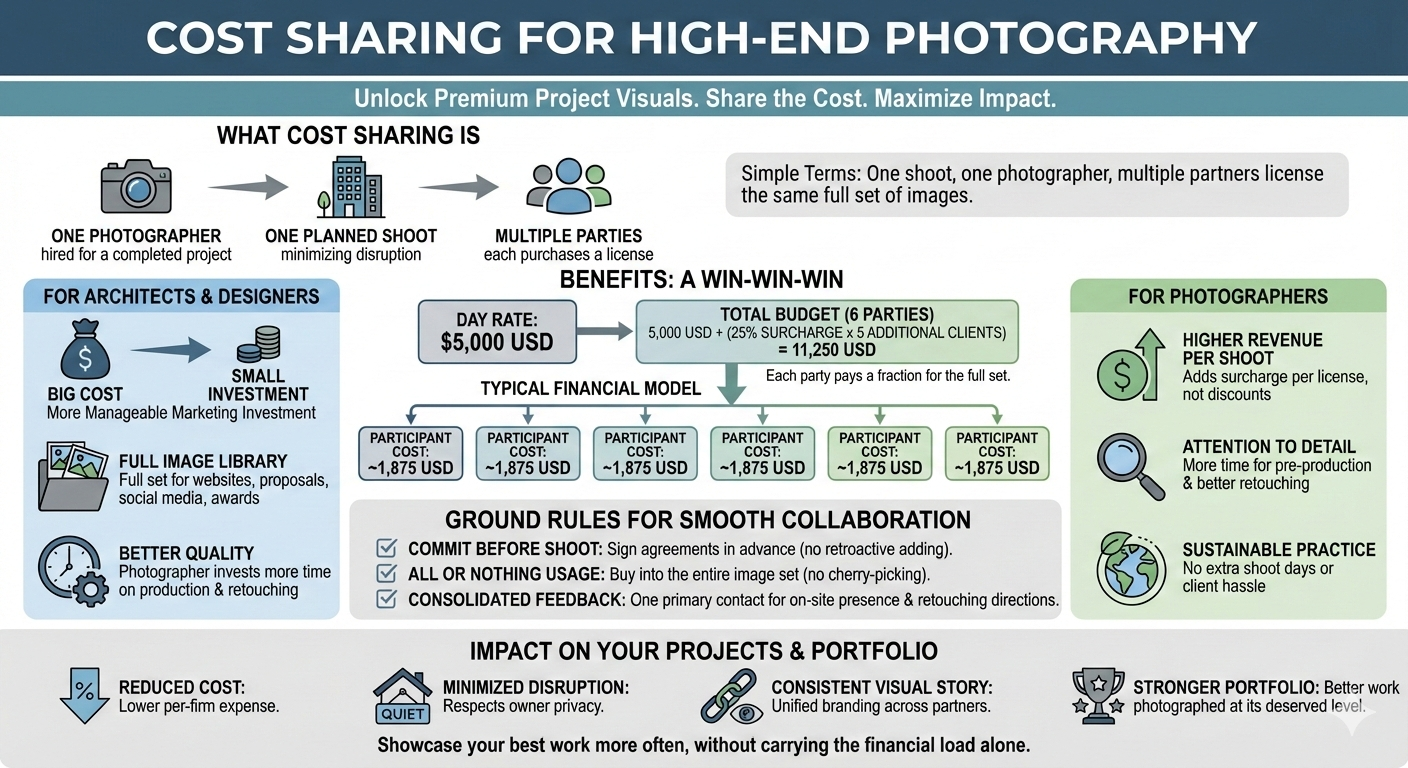
Cost sharing is one of the easiest ways for architects, designers, and other project partners to access high-end photography at a lower individual cost, while still commissioning a single, carefully planned shoot that respects everyone’s time and the property owner’s privacy.
What cost sharing is (in simple terms)
In a cost‑shared shoot, one photographer is hired to photograph a completed project and multiple parties each purchase a license to use the same set of images.
Typically the commissioning client is the architect or developer, and they invite other project partners—interior designers, landscape architects, builders, furniture and lighting manufacturers, art consultants, etc.—to join the pool before the shoot happens. This replaces the need for several separate photographers on different days, which most owners would never agree to anyway.
Why it benefits architects and designers
Cost sharing turns a “big” photography line item into a manageable marketing investment for smaller firms.
For example, instead of one architect paying the full fee for a shoot, that same project might be shared across five or six parties; everyone contributes a smaller amount, yet each receives a full, professionally produced image library they can use for websites, proposals, social media, and awards.
Because the total budget is higher, the photographer can often invest more time on pre‑production, shooting, and retouching, which directly improves the quality and longevity of the images in your portfolio.
Why it benefits the photographer (and ultimately you)
From the photographer’s side, cost sharing works by adding a surcharge for each additional license rather than discounting the original fee.
In a typical example, a day rate of 5,000 USD with a 25% surcharge per additional client becomes 11,250 USD when six parties participate, while each participant ends up paying about 1,875 USD for access to the same full set of images.
This structure increases the photographer’s overall revenue per shoot, allowing more attention to detail, better retouching, and a more sustainable practice—without requiring additional shoot days or asking the property owner to host multiple teams.
Ground rules that keep cost sharing smooth
To keep cost‑shared projects efficient and fair, it is important to set a few clear rules up front.
All participating parties must commit before the shoot and sign their agreements; cost sharing is not something that is added retroactively once images are finished.
Usage is “all or nothing”: participants are buying into the entire set rather than cherry‑picking a few favorites to license at a lower rate, which would undermine the structure.
Only one or two client representatives are present on site, and one primary contact (usually the commissioning architect or developer) consolidates retouching feedback so the photographer is not trying to reconcile five different edit directions.
With these boundaries in place, everyone knows what to expect, and the focus on shoot day can stay where it belongs: on crafting the strongest possible images of the project.
Why this is good for your projects
For a single project, cost sharing:
Reduces the per‑firm cost of high‑quality photography.
Minimizes disruption to owners and tenants by consolidating everything into one shoot.
Produces a consistent visual story of the project across all partners’ marketing and award submissions.
For your overall portfolio, it means more of your best work is photographed at the level it deserves, more often. That translates into stronger case studies, better proposals, and more compelling award entries across your entire body of work—without asking any one party to carry the full financial load alone.