
Architectural photography ROI: how great images translate into new projects, fees, and awards for your firm
Most architecture and development firms still treat photography as a line item to check off at the end of a project. They get a few shots for the website and move on. The firms that consistently win the best projects, raise their fees, and show up in awards and press think about photography very differently. They treat it as an investment that keeps working for them long after the final image is delivered.
In competitive markets, where clients are choosing between dozens of capable firms, the right photographs can be the difference between being shortlisted and being invisible.
Why Architectural Photography Is an Investment, Not an Expense
Prospective clients rarely read every word on your website or in your proposal, but they always see your images first. Those images answer three silent questions within seconds:
Does this firm design at the level I am looking for
Do they understand projects like mine in terms of scale, budget, and market
Do I feel confident trusting them with something this important
If your portfolio is a mix of phone snapshots, inconsistent styles, and one or two good projects, the answer is often “maybe.” And “maybe” is where you lose the project, not because of your design ability, but because of how it is presented. When your portfolio is built around a consistent body of high‑end photography, the reaction changes to “yes” before the first meeting, which affects who reaches out, what you are invited to pursue, and how much hesitation there is around your fee.
Case Study 1: One Project That Became a Lead Magnet
A mid-size firm completed a mixed-use project in a dense urban neighborhood. The original plan was to get a few basic exterior shots for their website. Instead, they approached the photography as a long-term asset and built a simple strategy with their photographer:
Capture the project at multiple times of day to show life, context, and light
Document not just hero angles but key program moments such as circulation, amenities, and how residents interact with the building
Deliver sets optimized for different uses, including large hero images for the website, tighter crops for proposals and awards, and social-ready verticals
Over the next 18 to 24 months, those images quietly did the heavy lifting.
The project became the firm’s most-viewed case study on their website
Prospective clients were bringing up that mixed-use project on calls, specifically referencing images they had seen online
At least one large new commission could be traced directly to a client first encountering those photos
From the outside, it looked like another finished project. Internally, everyone understood that one thoughtful shoot reshaped their pipeline.
Case Study 2: Elevating Perceived Value and Fee Levels
Another firm had excellent work but an uneven portfolio. Some projects had decent photography; others were documented with a mix of quick snapshots and one-off images from different people. The design quality was there, but the visual story was not.
Instead of focusing on chasing new work right away, they first fixed how their existing work was presented:
They prioritized a small group of key projects that best represented the firm’s future direction
They scheduled dedicated shoots to create a consistent visual language across those projects, aligning lighting, composition, and storytelling to the same standard
Alongside the new photography, they refreshed their website layout to let images lead, with concise, clear text supporting them
The result was subtle but powerful. Prospective clients began describing the firm as refined, polished, and high-end simply from browsing the portfolio. Pushback on fees diminished because the visuals supported the firm’s positioning at a higher tier, and existing clients were more proud to share the firm’s work internally and with partners.
The underlying design services did not change. The perception of those services did.
Case Study 3: Awards, Press, and the Compounding Effect of Visibility
Awards juries and editors are busy and often look at many submissions in a single sitting, so clarity and storytelling matter as much as aesthetics. A firm preparing to submit both a civic project and a hospitality project decided to plan photography around jury and editorial needs:
The shoot sequence was designed to tell a clear spatial story from arrival to transition, key program spaces, and details, including how people occupy the building
Images included essential context such as urban setting, landscape, and how the project relates to its surroundings, rather than isolated beauty shots
The final deliverables were structured to match submission formats and make it easy to build a coherent narrative
The outcomes over the next few years were significant.
Multiple awards shortlists and wins where jurors commented on how clearly they could understand the project through the images
Features in online and print publications that reached audiences far beyond the firm’s existing network
Partners including developers, consultants, and brands shared and reposted the images, multiplying exposure without additional marketing spend
None of this happened by accident. It came from aligning photography with clear goals from the start.
Where the Real ROI Comes From
It is tempting to think of return on investment as a simple equation of what was spent on photography versus one new project won. That narrow calculation misses most of the value.
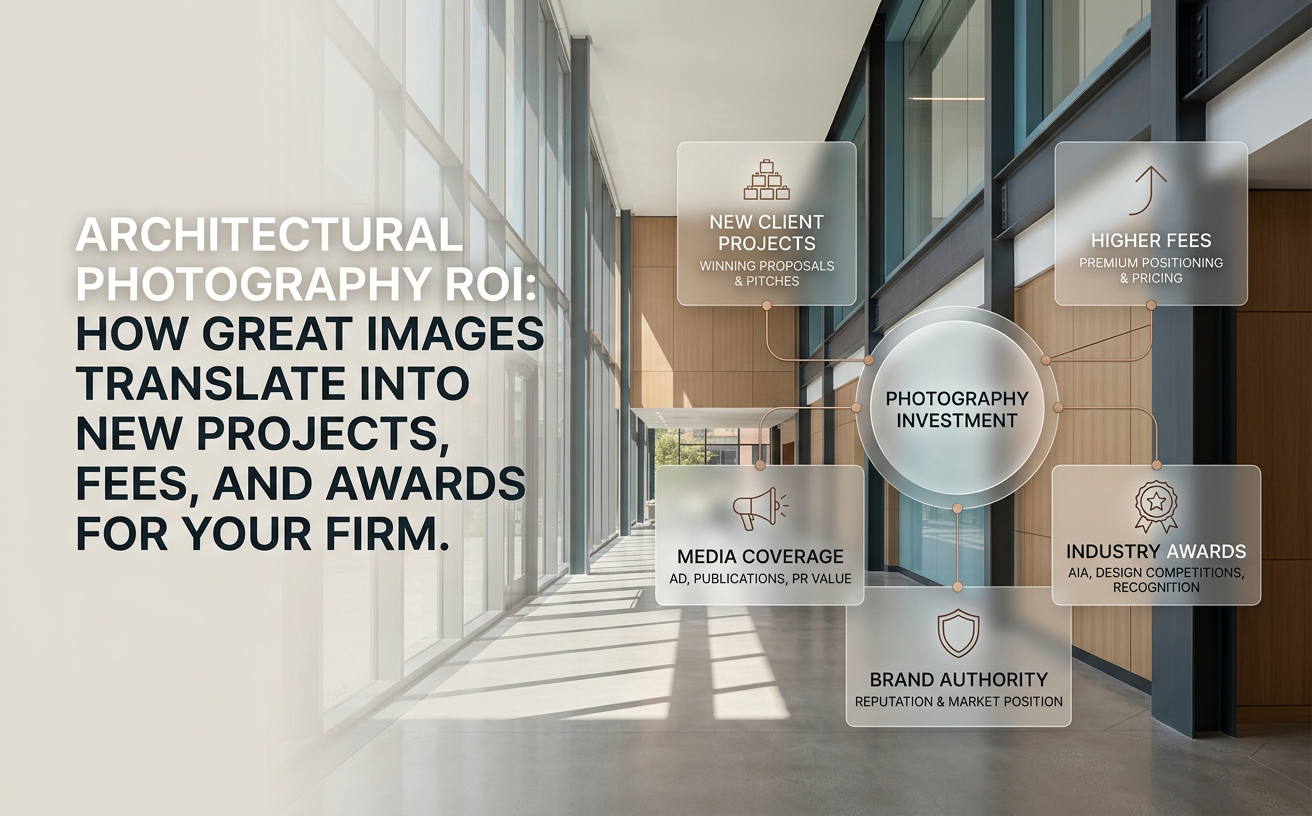
Great architectural photography produces returns across several fronts simultaneously:
Better leads, because strong images attract clients who recognize quality and are aligned with your level of work
Higher close rates, because a confident, clear portfolio makes clients feel safer choosing you
Higher fees, because a premium presentation supports premium pricing
Awards and press, because images that tell a clear project story give juries and editors a reason to say yes
Long-tail reuse, because the same images power your website, proposals, social media, talks, and partner marketing for years, lowering the effective cost per impression over time
There is also an internal benefit. A cohesive, well-photographed portfolio becomes part of your culture, and your team is more excited to share the work and advocate for the firm.
How to Approach Your Next Shoot Strategically
If you want your next project shoot to generate real return, treat it like any other important design decision.
Start with the end in mind, whether you are aiming for new project types, specific markets, higher fees, awards, or press, and share that with your photographer
Prioritize your flagship projects instead of trying to photograph everything at once, focusing on the work that best represents where you are going as a practice
Plan for multiple uses such as website hero images, proposal spreads, verticals for social, diagrams and overlays, and awards sequences, and build a shot list that covers them
Collaborate early and do not simply order photos at the end. Involve your photographer before styling, access, and scheduling are finalized, because timing and logistics often matter more than adding another shooting day
When you approach architectural photography this way, the question shifts from whether you can afford it to whether you can afford not to present your work at this level.
Closing Thought
Your portfolio is the only part of your practice that works all day, every day, representing you in rooms where you are not present. In a crowded field, the firms that invest in powerful, strategic photography are the ones that consistently attract better projects, command better fees, and stay visible in the conversations that matter. Treating architectural photography as a core business asset rather than a last-minute expense gives every future project you want to win a stronger starting point.