
How to brief your architectural photographer so your project wins awards
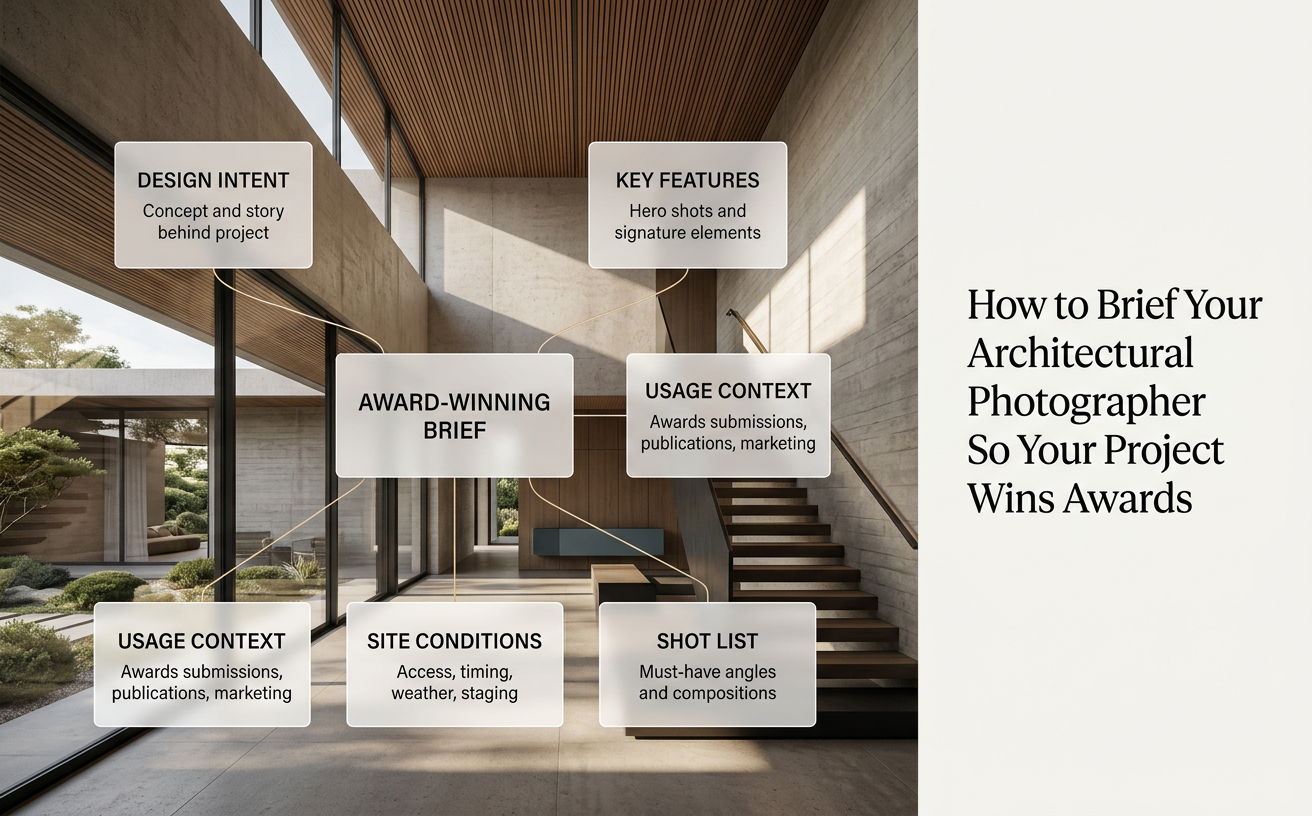
Winning design and architecture awards starts long before you open the awards portal—it starts with how you brief your photographer. A clear, strategic brief turns a regular project shoot into an awards-focused collaboration that gives juries exactly what they need to understand your work.
Start at the RFP: Define the Award Goals
Before you even hire your photographer, decide which awards you’ll pursue and what story you want to tell. Identify likely programs (AIA, Architizer A+Awards, Interior Design Best of Year, landscape or urban design awards) and note image requirements: number of images, orientation, presence of people, night shots, context views, etc.
In your RFP or initial inquiry, state clearly that the primary goal of the shoot is to support award submissions and high-level marketing. Share links or PDFs of past winning entries that you admire; this gives your photographer a visual benchmark for composition, storytelling, and level of polish.
Build the Brief: Narrative, Constraints, and Success Criteria
Your written brief should be short but precise. Start with a narrative paragraph: what problem did this project solve, what is unique about it, and what aspects you expect juries to care about (sustainability, adaptive reuse, social impact, urban integration, craft, technology, etc.).
Then outline practical constraints: access hours, security or privacy issues, areas that cannot be photographed, and any construction still in progress. Finally, define success criteria in concrete terms—e.g., “We need at least 5 award-ready hero images that clearly show the project’s relationship to context, key experiential sequences, and critical details.”
Create an Awards-Oriented Shot List
A room-by-room list is not enough for awards. Translate your narrative into a shot list that follows the same logic as a strong submission: context, approach, arrival, sequence, experience, and details.
For each category, specify must-have images:
Context and urban/site shots that show the project’s relationship to its surroundings.
Key experiential sequences (arrival, circulation, transitions between inside and outside).
Primary program spaces photographed from multiple angles and at multiple times of day.
Material and detail shots that support your description of craft, performance, or innovation.
Flag which images are “non‑negotiable” for awards and where the photographer has full freedom to explore additional views.
Align the Team: Who Owns What on Shoot Day
Award-focused shoots work best when the design team is actively involved. Assign a point person from your office who understands the awards strategy and can make real-time decisions on-site.
Decide in advance who is responsible for: access and coordination with building management; styling and decluttering (or hiring a stylist); recruiting any people to appear in the photos; and approving day‑of adjustments when conditions are different from the plan. Make sure your photographer has direct contact with this person so decisions can be made quickly when the light is perfect and time is tight.
Prepare the Building: Styling for Juries, Not Just Marketing
Awards juries look for clarity, coherence, and authenticity—spaces that read as designed, not over‑staged. Your brief should include visual guidelines for styling: what to remove, what to add, and how much “life” to show in each space.
For some awards, images with real users help communicate function and social value; for others, empty, pristine spaces are more appropriate. Give your photographer direction on where you want people included, what kind of activity should be visible, and where you want architecture to stand alone. This helps them plan shutter speeds, timing, and composition in advance.
Plan Timing and Light Specifically for Award Imagery
Instead of “one day of photos,” think in phases: early morning, daytime, dusk, and night, each serving a different purpose in telling your story. In your brief, identify which spaces are priority at each time of day based on orientation, views, and lighting conditions.
Awards juries often respond strongly to sequences that show a project across time—day and night versions of key views, or seasonal differences if applicable. If the budget allows, consider splitting the shoot over multiple days or returning later in the year to capture greenery, occupancy, or improved weather aligned with your award calendar.
Be Explicit About Usage, Licensing, and Credit
Awards submissions, press, and multi-party marketing (architect, interior designer, landscape architect, developer, brand) often require broad, multi-platform usage of images. Address this in your brief and contract so there are no surprises later.
Spell out that the images will be used for: awards submissions, websites, social media, printed portfolios, lectures, and PR, potentially by multiple project partners. Ask your photographer how they structure licensing for multi‑stakeholder use and what credit line they prefer, then build that into your internal templates so it is consistently applied in every submission.
Collaborate on Editing: From Contact Sheets to Awards Selects
The brief doesn’t end when shoot day is over. The way you collaborate on editing and selects is crucial for awards. Plan a joint review session where you and the photographer walk through initial edits with your award criteria in mind: clarity of concept, legibility of design moves, and diversity of vantage points.
Ask your photographer to propose a “core awards set” of 10–20 images that could stand alone as a complete narrative. In that review, make sure you have: at least one strong context image, a clear sequence of spaces, and close‑ups that support specific claims you plan to make in the written submission (e.g., material performance, sustainability strategies, or community integration).
Tailor Final Selects to Each Award
Different awards emphasize different aspects of a project—some lean conceptual, others technical or typological—so your final selects should be tuned accordingly. Share your short list of awards with deadlines and categories, then build small, curated image sets for each one rather than reusing the same 10 photos everywhere.
Where possible, ask your photographer for subtle variations (with and without people, slightly different crops, alternates at different times of day) to give you flexibility. A well-briefed shoot makes this easy because the photographer anticipated these needs during capture.
Turn One Project into a Long-Term Asset
When you brief with awards in mind, you end up with a library that serves far more than a single submission: website case studies, monographs, talks, social media campaigns, and future RFPs all benefit from the same carefully planned imagery. That is the real ROI of a good brief—it multiplies the impact of one project across years of your firm’s growth.
Think of your photographer as a strategic partner in that process. Share your long-term goals, involve them early, and give them a clear, awards-focused brief, and you dramatically increase the chances that juries see your project the way you designed it to be seen.